
You finished your manuscript. That alone puts you ahead of most people who say they want to write a book but never do. Seriously—take a moment for that.
But here’s the part nobody warns you about: the first draft is where the story starts, not where it ends. What separates a manuscript sitting in a drawer from a book sitting on a shelf is editing. And not just one kind of editing—several, each doing something different.
Most first-time authors think editing means someone fixes their commas and catches typos. That’s part of it, sure. But it’s like saying a home renovation is just painting the walls. Before you pick colors, someone needs to check whether the foundation is solid, the layout makes sense, and the plumbing works.
This guide breaks down exactly what each type of editing does, when you need it, and when you can skip it. We’ll also walk through before-and-after examples so you can see the difference each stage makes in practice.
The 6 Types of Book Editing at a Glance
Before we dig into the details, here’s a quick reference. Bookmark this—you’ll come back to it.
| Type | What It Does | You Need This If… | Typical Timing |
|---|---|---|---|
| Editorial Assessment | Big-picture evaluation delivered as a feedback letter | You’re unsure what’s working and what isn’t | Before any other editing |
| Developmental Editing | Deep structural work on plot, characters, pacing, organization | Your story has holes, pacing issues, or unclear structure | First major edit |
| Line Editing | Refines how every sentence reads—rhythm, voice, clarity | Your structure is solid but the prose feels flat or uneven | After developmental editing |
| Copy Editing | Fixes grammar, punctuation, spelling, and consistency | Your writing is polished but needs technical accuracy | After line editing |
| Proofreading | Final sweep for typos, formatting errors, and small mistakes | You’re about to publish | Very last step |
| Fact-Checking | Verifies all claims, dates, statistics, and references | You’ve written nonfiction, historical fiction, or anything research-based | Alongside or after copy editing |
Now let’s look at each one properly.
Editorial Assessment
Think of an editorial assessment as a diagnostic appointment for your manuscript. You’re not getting surgery—you’re getting a professional opinion on what’s healthy and what needs attention.
An editor reads your entire manuscript and delivers a written report (usually 3–10 pages) covering the big stuff: Is the structure working? Are the characters compelling? Does the pacing hold up? For nonfiction, they’ll look at whether your argument flows logically, whether chapters are sequenced in a way that builds understanding, and whether your target reader would actually stick with it.
The editorial assessment doesn’t change a single word of your manuscript. What it gives you is direction. It tells you where to focus your energy before you start the heavier editing stages.
Who should get one: First-time authors, writers who feel “stuck” and can’t figure out why their manuscript isn’t clicking, and anyone who wants an honest outside opinion before investing in a full developmental edit.
Who can skip it: Authors who’ve already received detailed feedback from beta readers or critique partners and feel confident about their structure.
What an Editorial Assessment Looks Like in Practice
The kind of feedback you’d receive:
“Your opening three chapters spend too much time on backstory before introducing the central conflict. Consider starting with the scene in Chapter 4 where Nora discovers the letter—it immediately raises a question the reader wants answered. The backstory can be woven in later through dialogue and memory.”
Notice this isn’t line-level editing. Nobody’s touching your sentences. They’re telling you the building has a structural issue and suggesting how to fix it.
2. Developmental Editing
This is the big one. Developmental editing is the most intensive, most transformative type of editing a manuscript can go through.
Where an editorial assessment hands you a map, developmental editing gives you turn-by-turn directions—and sometimes grabs the wheel. A developmental editor works through your manuscript chapter by chapter, leaving detailed margin notes, suggesting restructures, flagging plot holes, questioning character motivations, and pointing out where readers might lose interest.
You’ll typically receive two things: your manuscript marked up with comments and suggestions, plus a summary editorial letter pulling everything together.
For fiction, a developmental editor focuses on:
- Plot structure and whether the story earns its ending
- Character arcs—do characters change in believable ways?
- Pacing—are there chapters that drag or moments that feel rushed?
- Dialogue—does it sound like real people talking, or like the author talking through characters?
- Scene transitions and whether the reader always knows where they are
- World-building consistency (especially for genre fiction)
- Theme—is the book actually about what you think it’s about?
For nonfiction, the focus shifts to:
- Whether chapters are sequenced in a logical order
- Whether ideas are introduced before the reader needs them
- Whether arguments are supported with enough evidence
- Whether the book delivers on the promise of its introduction
- Whether the tone matches the target audience
Before and After: Developmental Editing
Before (original draft):
Sarah had always been afraid of water. She grew up near a lake. Her mother had drowned when Sarah was seven. Now she stood at the edge of the ocean, thinking about everything that had happened. She felt scared but also determined. She was going to swim today no matter what.
After (developmental edit applied):
The tide crept toward Sarah’s bare feet, and she locked her knees to keep from stepping back. Twenty-three years since her mother disappeared beneath the surface of Lake Moraine, and salt water still made her hands shake. She curled her fingers into the damp fabric of her towel. Today she’d get past the breakers. She’d promised Lily, and unlike her own mother, Sarah kept her promises.
The information is the same. But the second version shows instead of tells, weaves in backstory naturally, and introduces a relationship that raises new questions. That’s what developmental editing does—it doesn’t just identify problems, it helps you see how to solve them.
3. Line Editing
Line editing is the stage most people picture when they think of “editing,” even though it’s actually the third step in the process.
A line editor reads your manuscript sentence by sentence, focusing on how the writing sounds. They’re not looking at plot holes (that was developmental editing) and they’re not hunting for grammar mistakes (that’s copy editing). They’re working on voice, rhythm, word choice, and clarity.
Good line editing makes writing feel effortless to read—even when the ideas are complex. It’s the difference between a paragraph you have to re-read three times and one that carries you forward without thinking.
What a line editor works on:
- Sentence rhythm: Varying sentence length so the prose doesn’t feel monotonous. Short sentences create tension. Longer ones allow ideas to breathe and develop.
- Word choice: Swapping vague or overused words for precise ones. “She walked quickly across the room” becomes “She crossed the room in three strides.”
- Redundancy: Cutting phrases that repeat what’s already been said. Writers do this more than they realize.
- Tone consistency: Making sure Chapter 12 doesn’t suddenly sound like a different author wrote it.
- Clarity: Untangling sentences where the meaning gets lost in the structure.
Before and After: Line Editing
Before:
The company’s approach to innovation was very unique and different from other companies in the industry. They really focused on making sure that their employees felt like they could bring new ideas to the table without fear of being judged or criticized by management.
After:
The company treated innovation differently than its competitors. Employees pitched ideas directly to leadership without a formal review process—an approach that eliminated the gatekeeping most organizations build into their culture by default.
Same meaning, half the words, twice the impact. The line editor didn’t change what the author was saying—they changed how it landed.
4. Copy Editing
Copy editing is where the technical precision happens. At this stage, your structure is solid, your prose is polished, and now someone needs to make sure you haven’t spelled your character’s name two different ways or used a semicolon where you needed an em dash.
A copy editor reviews your manuscript for grammar, punctuation, spelling, capitalization, consistency, and adherence to a style guide (typically Chicago Manual of Style for books). They’ll also create or maintain a style sheet—a reference document tracking things like character names, place names, timeline details, and any stylistic choices you’ve made (like whether you capitalize “the Internet” or write “internet”)
What copy editors catch that you won’t:
- You spelled the protagonist’s hometown “Greystone” in Chapter 2 and “Graystone” in Chapter 14
- You used “which” where you needed “that” (or vice versa) forty-seven times
- Your dialogue tags alternate between American and British punctuation conventions
- A character drinks coffee in the morning scene, but two paragraphs later the narration mentions she “set down her tea”
- You accidentally switched from past tense to present tense for half a page
These are the kinds of mistakes your brain will skip right over because you know what you meant. A copy editor doesn’t know what you meant. They only know what’s on the page—and that’s exactly why they catch things you can’t.
Before and After: Copy Editing
Before:
“Its going to be fine” she said, tightening her gripped on the stearing wheel. The road, that stretched endlessly ahead, shimmered in the July heat.”
After:
“It’s going to be fine,” she said, tightening her grip on the steering wheel. The road that stretched endlessly ahead shimmered in the July heat.”
Four corrections in two sentences: a missing apostrophe, a missing comma after dialogue, a word-form error (“gripped” → “grip”), a misspelling (“stearing” → “steering”), and a removed comma around a restrictive clause. Small fixes, big difference in how professional the writing looks.
5. Proofreading
Proofreading is the last pair of eyes on your manuscript before it goes to print or gets uploaded for digital distribution. It’s not the place for structural feedback or prose polishing—all of that should be finished by now.
A proofreader is looking for the small stuff that slipped through every previous round: a missing period, a duplicated word (“the the”), a page number that skipped from 84 to 86, a header that says “Chapter Fifteen” when the content is actually Chapter Sixteen.
Proofreaders check for:
- Typos and misspellings that survived copy editing
- Missing or duplicated words
- Incorrect punctuation
- Formatting inconsistencies (font changes, irregular spacing, indentation issues)
- Page numbering errors
- Widows and orphans (single lines stranded at the top or bottom of a page)
- Table of contents accuracy
For ebooks specifically, proofreaders also review:
- Hyperlink functionality
- Clickable table of contents
- Formatting across different screen sizes
- Image placement and resolution
This isn’t the most glamorous stage of editing, but skipping it is how you end up with a one-star review that says “I found six typos in the first chapter.” Readers notice. They always notice.
6. Fact-Checking
If you’ve written nonfiction—or historical fiction, or anything that references real events, people, statistics, or science—fact-checking is a stage you shouldn’t skip.
A fact-checker reads your manuscript with one goal: verifying that every claim you’ve made is accurate. Dates, statistics, quotes, scientific claims, historical events, name spellings of real people, geographic details—all of it gets checked against reliable sources.
This matters more than most authors realize. One wrong statistic in a business book, one misattributed quote in a memoir, and your credibility takes a hit that no amount of good writing can fix.
Fact-checking is especially important for:
- Business and finance books
- History and biography
- Science and health writing
- True crime
- Political commentary
- Memoir (yes—memory is unreliable, and a fact-checker can catch where yours has drifted)
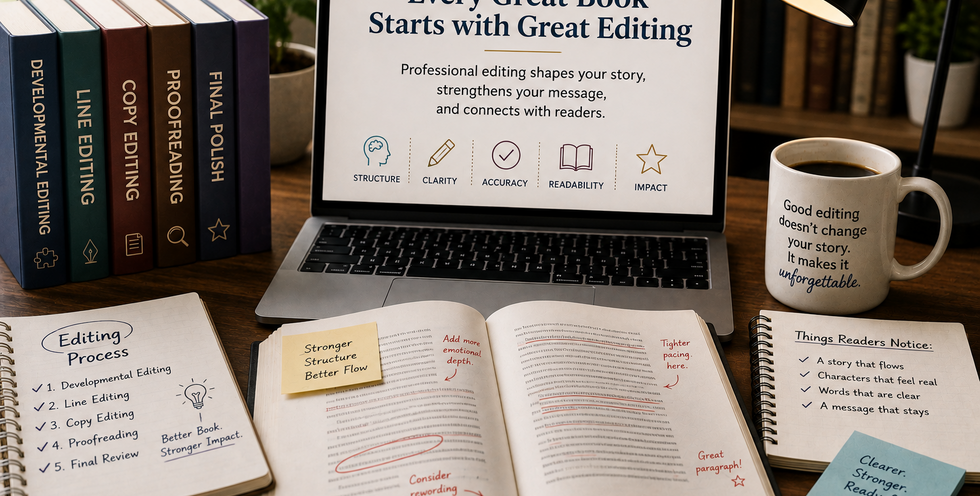
How the Full Book Editing Process Works
Here’s the reality: you probably won’t need every single type of editing listed above. But understanding the full sequence helps you figure out where your manuscript is and what it needs next.
Step 1 — You finish your draft and let it sit. Seriously. Put it away for at least two weeks. When you come back, you’ll see problems you were blind to before.
Step 2 — Self-edit. Read through and fix what you can on your own. Focus on the big stuff: Does the story make sense? Are there chapters that feel unnecessary? Is the ending earned?
Step 3 — Editorial assessment (optional). If you’re unsure where to start, an assessment gives you a roadmap before you invest in heavier editing.
Step 4 — Developmental editing. The deep structural work. This is where major changes happen—chapters get moved, characters get reworked, whole sections might get cut or rewritten.
Step 5 — You revise based on feedback. The developmental editor identifies problems and suggests solutions. You do the rewriting.
Step 6 — Line editing. Now that the structure is solid, the prose gets refined.
Step 7 — Copy editing. Technical accuracy and consistency.
Step 8 — Final proofreading. The last safety net before publication.
Not every manuscript needs all eight steps. A polished draft from an experienced writer might skip straight to copy editing. A first-time author’s manuscript might need the full sequence. The point is to work from big-picture down to detail—never the other way around. Fixing commas in a chapter that’s going to get cut is wasted effort.
Fiction vs. Nonfiction: How Editing Differs
The stages of editing are the same for fiction and nonfiction, but the focus at each stage shifts significantly.
Editing a Novel
Novel editing puts storytelling front and center. A developmental editor working on a novel is asking questions like: Does the protagonist change in a way that feels earned? Is the antagonist more than a cardboard cutout? Does the romance subplot actually serve the main story, or is it just filler? Are there scenes that exist only because the author enjoyed writing them, not because the reader needs them?
Dialogue gets particular scrutiny in fiction. Characters should sound distinct from one another—a teenager shouldn’t talk like a professor, and a mechanic from rural Georgia shouldn’t sound like a lawyer from Manhattan (unless that contrast is the point).
Editing a Nonfiction Book
Nonfiction editing prioritizes clarity, logic, and reader understanding. The developmental editor’s job isn’t to make the story more exciting—it’s to make sure the reader can follow your argument, learn from your expertise, and stay engaged long enough to finish.
For educational and instructional books, a skilled editor ensures that concepts build on each other in the right order, that jargon is explained before it’s used, and that each chapter delivers on its promise. A good textbook editor is worth their weight in gold because they’ll catch the moment where you, the expert
Common Editing Mistakes That Cost Authors Time and Money
After working with hundreds of manuscripts, patterns emerge. These are the mistakes we see most often:
Jumping straight to copy editing. This is the most expensive mistake a first-time author can make. If your story structure has problems—if the pacing is off, if characters aren’t compelling, if the second act sags—no amount of grammatical polish will save it. Fix the foundation first.
Relying on spell-check and grammar tools. Grammarly, ProWritingAid, and similar tools are useful for catching surface errors during self-editing. They are not a substitute for a human editor. They can’t tell you that your plot twist is predictable, that your character’s motivation doesn’t make sense, or that your Chapter 7 reads like you were exhausted when you wrote it. They also tend to flatten your voice, flagging stylistic choices as “errors.”
Editing immediately after finishing the draft. Your brain needs distance from the manuscript to evaluate it clearly. After months of writing, you’re too close. You’ll read what you intended to write, not what’s actually on the page. Even a two-week break makes a noticeable difference.
Ignoring editorial feedback you disagree with. Not every suggestion an editor makes will be right for your book. But if an editor flags something as a problem—even if you disagree with their proposed solution—the problem itself is usually real. If one reader is confused, more will be.
Trying to do everything in one pass. Some authors hire a single editor and expect developmental editing, line editing, copy editing, and proofreading all at once. This rarely works well. Each stage requires a different mindset. The editor looking at your story structure shouldn’t simultaneously be worrying about comma placement—and vice versa.
How to Find the Right Book Editor
The right editor makes your book better while keeping it yours. The wrong one rewrites your voice out of existence. Here’s how to tell the difference:
Look for genre experience. An editor who specializes in literary fiction will approach your thriller differently than an editor who lives and breathes thrillers. Genre editors understand reader expectations—they know what the audience is looking for and where your manuscript delivers (or doesn’t).
Ask for a sample edit. Most professional editors will edit a few pages of your manuscript (often 1,000–2,000 words) so you can evaluate their approach before committing. If an editor won’t do this, keep looking.
Read their editorial letter or feedback style. Good editors explain the “why” behind every suggestion. “Cut this scene” isn’t helpful. “This scene repeats information the reader already learned in Chapter 3, and it slows the pacing right before your climax” gives you something to work with.
Check whether they rewrite or refine. Your book should still sound like you when the editor is done. If you read the sample edit and don’t recognize your own voice, that’s not the right fit.
Freelance Editor vs. Editing Company: Which Is Right for You?
Both options work. The right choice depends on what your manuscript needs.
Freelance editors tend to offer a deeply personal, one-on-one collaboration. You’re working directly with the person reading your pages. For authors who want a close creative partnership—especially during developmental editing—this can be ideal.
Editing companies (like BookCraftInk) offer a team. That means access to specialists at every stage: a developmental editor who focuses on story structure, a copy editor who knows the Chicago Manual of Style backward and forward, a proofreader with an eagle eye for detail. You don’t have to find and vet each one separately—the company handles that coordination.
The right choice depends on your budget, your timeline, and how much hands-on guidance you want throughout the process.
Who Benefits from Professional Editing?
Short answer: everyone who wants their book to be read.
That includes first-time novelists who need help shaping a rough draft into a real story. It includes business professionals writing their first book to establish authority in their field. It includes memoirists trying to turn personal experience into something that resonates with strangers. It includes self-publishing authors who don’t have a traditional publisher’s editorial team behind them. And yes, it includes experienced authors on their fifth or tenth book—because even seasoned writers can’t objectively evaluate their own work.
Professional editing isn’t a sign that your writing isn’t good enough. It’s a sign that you take your readers seriously enough to give them the best possible version of your book.
Why Choose BookCraftInk?
We’ve worked with first-time authors who didn’t know what developmental editing was and bestselling writers who needed a final proofread before going to press. Every manuscript is different, and we treat it that way.
Our editorial team doesn’t run your manuscript through a formula. We read it, figure out what it needs, and tailor our approach to your specific project—whether that’s a deep structural overhaul, a careful line edit, or a final polish before launch day.
Beyond editing, we also help authors with ghostwriting, self-publishing support, Amazon KDP publishing, book cover design, audiobook production, author website development, and book marketing. The goal is simple: take your book from where it is to where you want it to be.
Final Thoughts
No manuscript is ready after the first draft. That’s not a flaw—it’s how writing works.
The difference between a book that sits in a drawer and one that finds its audience usually comes down to editing. Not just checking for typos, but the real work: questioning the structure, tightening the prose, catching inconsistencies, and making sure every chapter earns its place.
You don’t need to understand every technical detail of the editing process to benefit from it. You just need to know what exists, what your manuscript needs, and when to bring in someone who can see what you can’t.
That’s what this guide is for. And when you’re ready, that’s what we’re here for.
Frequently Asked Questions
What are book editing services?
Book editing services cover the full spectrum of professional editing—from editorial assessments and developmental editing that address structure and storytelling, through line editing and copy editing that refine your prose, to final proofreading that catches any remaining errors before publication.
What does a novel editor do?
A novel editor evaluates how well your story works as a whole. They look at plot structure, character development, pacing, dialogue, scene transitions, and thematic consistency to help you write a stronger, more engaging book. Depending on the stage, they might suggest major structural changes or fine-tune individual sentences.
What is the difference between manuscript editing and proofreading?
Manuscript editing (developmental and line editing) focuses on improving the content itself—strengthening the story, clarifying ideas, and refining the writing. Proofreading is the final quality check that catches small remaining errors like typos, punctuation mistakes, and formatting inconsistencies. Editing changes how the book reads; proofreading makes sure it’s clean.
How do I find a book editor?
Start by looking for editors with experience in your specific genre. Ask for a sample edit so you can evaluate their style. Read testimonials or ask for references. A good editor explains the reasoning behind their suggestions and improves your writing without erasing your voice.
Are professional book editing services worth the investment?
For most authors, yes. Professional editing catches problems you can’t see yourself, strengthens your manuscript in ways that directly affect reader engagement and reviews, and gives your book the polish that readers and industry professionals expect. It’s one of the highest-impact investments you can make in your book’s success.
How much does book editing cost?
Costs vary depending on the type of editing, the length of your manuscript, and the editor’s experience. As a rough guide, developmental editing typically costs more than copy editing, which costs more than proofreading. Most editors price by word count. Request quotes from several editors so you can compare rates and services.
Do I need every type of editing?
Not necessarily. A well-developed manuscript from an experienced author might only need copy editing and proofreading. A first draft from a new writer might benefit from the full sequence starting with developmental editing. The key is to work from big-picture issues down to details—never the reverse.