


Finishing a manuscript is a major achievement. Deciding how to turn it into a published book brings a different set of questions: What kind of editing does it need? Which formats should you release? What should a publishing service actually handle?
Those decisions shape your self-publishing budget. A revised novel with a simple interior needs a different production plan from an illustrated children’s book, a business guide, or a memoir that still needs structural work.
Rather than start with a package name, start with the book itself. Understanding the work ahead makes it easier to compare services, avoid unnecessary extras, and decide where professional support would be most useful.
This guide explains what affects self-publishing costs, what to check in a proposal, and how to prepare for a conversation about your project.
Why Every Book Needs Its Own Publishing Plan
Word count matters, but it does not tell the whole story.
Two manuscripts of similar length may arrive at very different stages. One author has worked through several revisions and resolved the main structural problems. Another has a promising draft but still needs to develop the argument, reorganize chapters, or strengthen the ending.
The publishing work will differ even if both authors want an ebook and a paperback.
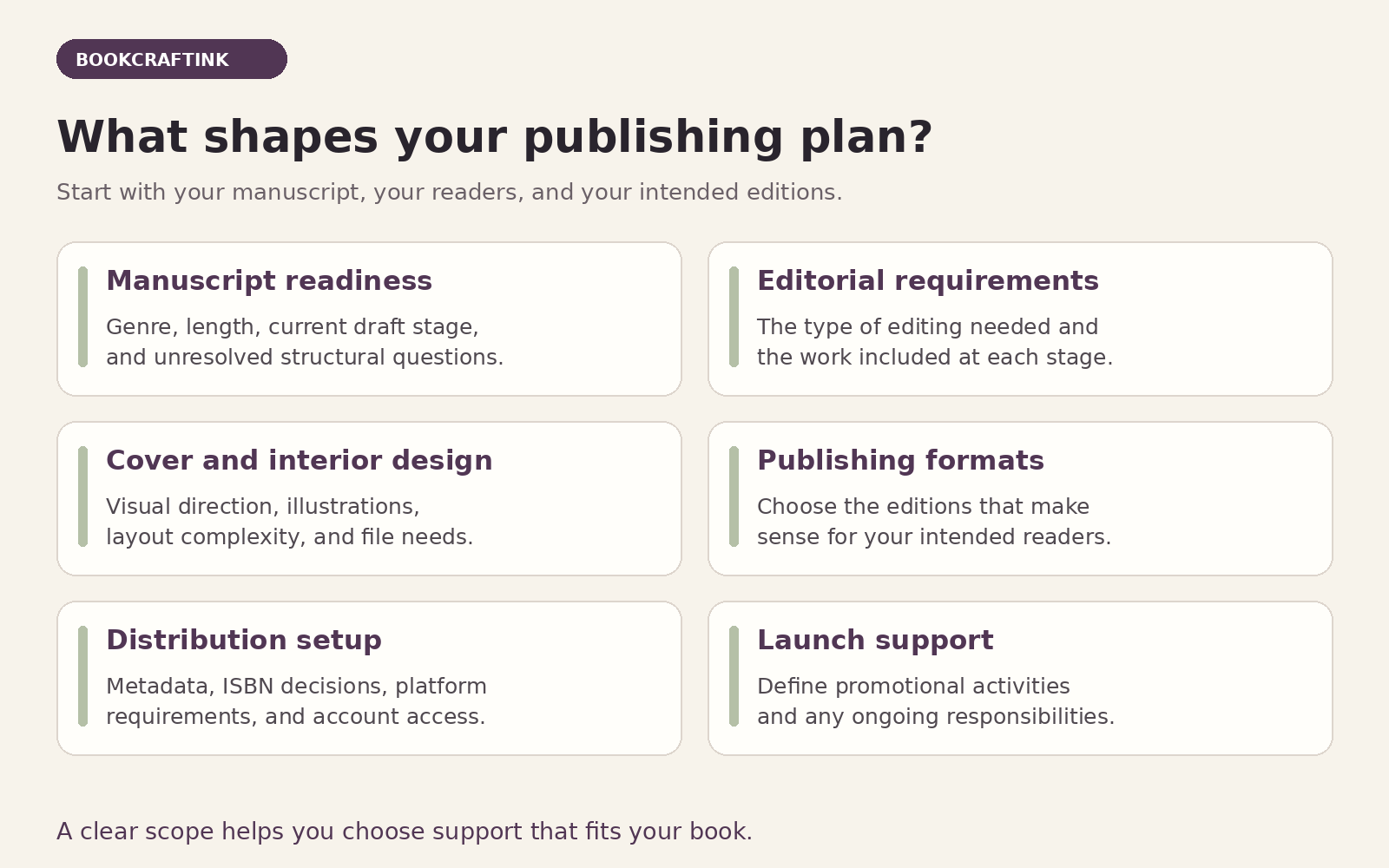
Your plan should account for:
- The genre and intended reader.
- The manuscript’s length and current condition.
- The type of editing required.
- The formats you want to publish.
- The complexity of the cover and interior.
- Your intended distribution channels.
- Your deadline and availability for revisions.
A useful proposal connects each service to one of these needs. If you cannot tell why a service is included, ask what problem it is meant to solve.
The Main Factors That Affect Self-Publishing Costs
Manuscript Readiness
A manuscript does not need to be perfect before you seek help. However, its stage should be clear.
If chapters are still moving around or major sections remain unwritten, final formatting is probably premature. If the structure works but the language needs attention, sentence-level editing may be the next step.
Before approaching a provider, describe what you have already done. Mention previous editorial feedback, substantial revisions, reader feedback, and any concerns you have not resolved.
Being honest about the manuscript’s condition helps the provider recommend a suitable scope. It also reduces the risk of commissioning work that needs to be repeated after major changes.
Editing and Proofreading Requirements
Editing is not one uniform service. Different stages address different problems.
Developmental editing looks at matters such as structure, pacing, argument, and organization. Line editing focuses on how the writing communicates at the sentence and paragraph level. Copyediting addresses matters such as grammar, consistency, and usage. Proofreading is a final check for remaining errors in the prepared text.
Providers may define or combine these services differently, so ask what their terms mean in practice. A package labeled “editing” does not automatically include every stage.
You can use our guide to the types of book editing to understand the distinctions before discussing your manuscript.
Ask whether the proposed work includes an editorial report, tracked changes, a style sheet, or a follow-up discussion. If your book needs fact-checking, reference checking, or permissions research, confirm whether those tasks are included or separate.
Cover Design Scope
A book cover is not just a front image. The deliverables depend on the editions you plan to release.
An ebook needs a digital front cover. A paperback also needs a spine and back cover prepared to the printer’s specifications. A hardcover may require another version, depending on the production method.
The design process also changes when a project needs custom illustration, photography, complex image manipulation, or a consistent look across a series.
A good design brief explains the genre, audience, mood, title, and planned formats. Reference covers can help communicate your preferences, but the goal should be an appropriate original design—not a copy of another author’s book.
Ask how concepts and revisions are handled, which files you will receive, and what licenses apply to images and fonts. BookCraftInk’s cover design services provide a starting point for discussing your book’s visual requirements.
Interior Formatting and Layout
Formatting requirements depend on what appears inside the book.
A text-based novel may have a straightforward interior. A cookbook, workbook, or business guide could involve images, tables, diagrams, footnotes, or areas where the reader writes directly on the page.
Ebook and print files also serve different purposes. A reflowable ebook allows text to adapt to the reader’s screen and settings. A print interior has fixed pages and needs careful attention to margins, page breaks, running heads, and other layout details.
Tell your formatter about anything beyond ordinary text before the work begins. Include image files, caption requirements, special characters, and accessibility needs.
Clarify how corrections will be handled after the first layout. Small adjustments and substantial manuscript revisions are not the same kind of work.
Publishing Formats
You do not have to release every possible format at once.
An ebook and paperback may suit your initial plans. A hardcover, audiobook, illustrated edition, or translation creates additional decisions and production requirements.
An audiobook, for example, involves narration and audio production rather than simply exporting a manuscript into another file type. An illustrated edition may require new layout work and a different proofing process.
Think about how your intended readers are likely to use the book. A practical workbook may depend on its physical format, while a text-focused novel may work well in both print and digital editions.
Choose formats because they serve the book and its audience, not because a package happens to list them.
Distribution and Publishing Setup
Where you want the book to be available affects the setup process.
Your plan may involve a single publishing platform, multiple retail channels, or a broader distribution arrangement. Each option needs an understanding of account access, metadata, file requirements, and the terms that apply.
ISBN decisions also depend on your formats and publishing arrangements. An ISBN identifies a particular edition; it is not copyright registration. Check KDP’s ISBN and imprint guidance if you plan to use that platform.
Ask who will manage your accounts and where sales reports and payments will be accessible. Make sure the agreement explains what happens if you later decide to manage publication yourself or work with a different provider.
Availability through a distribution channel does not guarantee that bookstores will stock the book. Keep distribution access separate from promises about demand.
Separate Essential Work From Optional Additions
A long list of services can make a package look comprehensive without showing which parts your book actually needs.
Start by identifying the work required to prepare the editions you have chosen. Then consider launch activities and later additions separately.
| Stage | What to consider | Question to ask |
|---|---|---|
| Manuscript preparation | Revision and appropriate editorial support | Is the text ready for production? |
| Book production | Cover design, interior files, and proof checks | What must be completed for the chosen editions? |
| Publishing setup | Metadata, accounts, and distribution arrangements | Who is responsible for each setup task? |
| Launch support | Promotional materials, outreach, and campaign planning | Which activities have a clear purpose? |
| Later development | Additional formats, updates, or ongoing support | Does this need to happen now? |
This approach does not mean marketing is unimportant. It means a book-production decision and a promotion decision should each have a clear reason behind them.
A website, newsletter, or advertising campaign may help support your author activity, but it should not be added simply because the option is available. Understand what you will use, who will manage it, and what ongoing commitments it creates.
What to Ask Before Choosing a Publishing Service
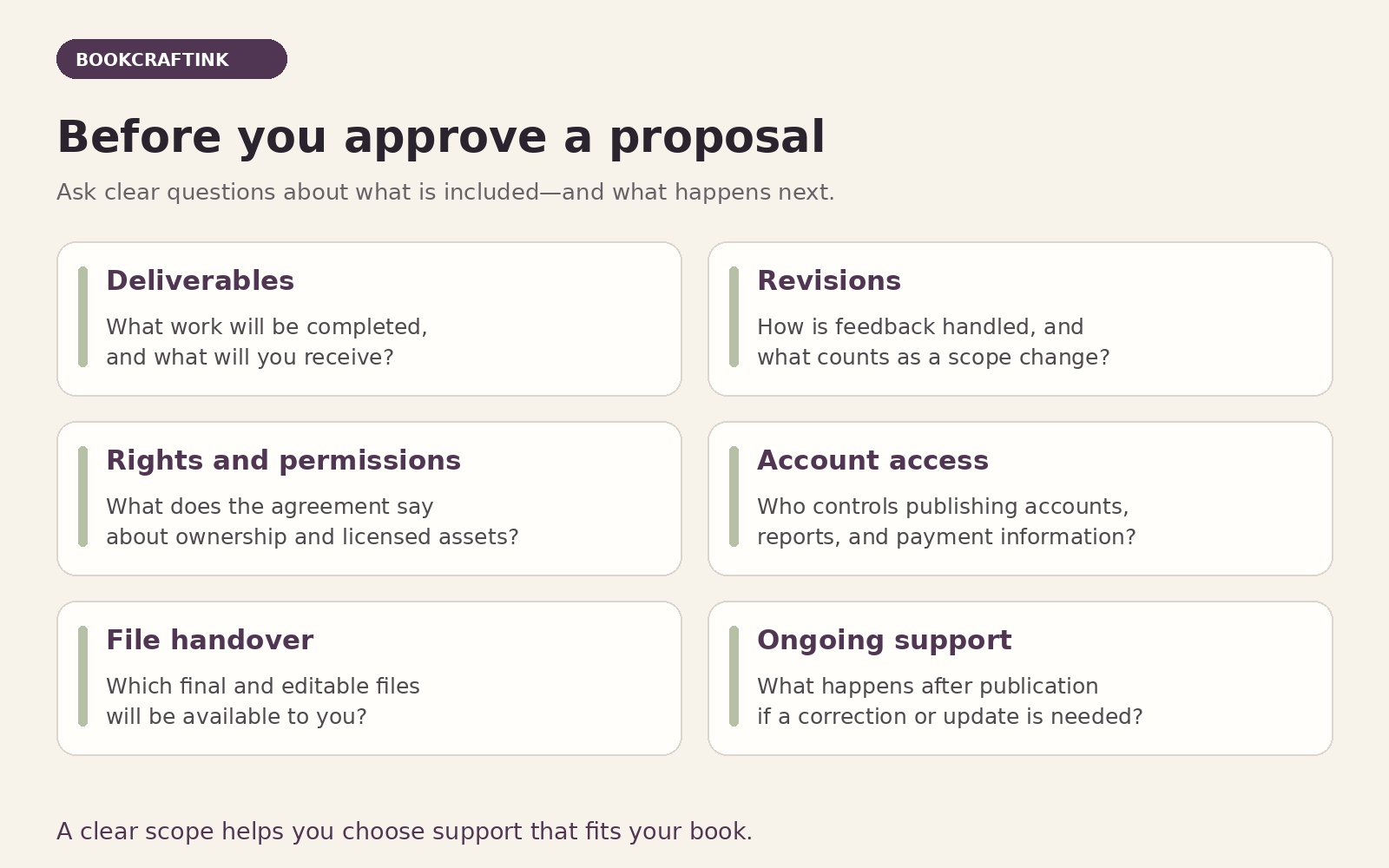
A useful proposal tells you what will be done, who will do it, and what you will receive. Broad terms such as “full support” need practical definitions.
What Does Each Service Include?
Ask for the actual deliverables. For editing, that may include a marked-up manuscript and editorial notes. For design, it should identify the formats and file types you will receive.
If project management is included, clarify who your main contact will be and how approvals will happen.
How Are Revisions Handled?
Find out how many review stages are included and what counts as a revision. Correcting a layout issue is different from adding a new chapter after the interior has been approved.
Ask how work outside the original scope is identified and authorized. Changes should not come as a surprise after the work has already been performed.
Who Controls the Accounts and Files?
Understand who has access to publishing accounts, production files, and reporting information.
Do not assume that receiving a finished PDF means you will also receive the editable source files. Confirm the handover arrangements in writing, including any limitations involving licensed assets or software.
What Does the Agreement Say About Rights?
Read the ownership and licensing provisions rather than relying on general assurances.
The agreement should explain the rights relevant to the work being supplied and any permissions the provider needs. If a contract contains unfamiliar restrictions or complicated rights arrangements, seek appropriate professional advice before signing.
What Happens After Publication?
A file may need a correction after release, or you may decide to update the description or add another edition.
Ask what post-publication support covers, how long it lasts, and how future requests are handled. A clear handover is useful even if you expect to keep working with the same team.
Overlooked Details That Can Change the Project
The largest tasks are often easy to identify. Smaller requirements are more likely to be missed until production is underway.
Image permissions: An image being available online does not mean it can be reproduced in your book. Confirm the rights and keep records of any licenses.
Quotation permissions: Some material may need permission before it can be included. Do not assume that a credit line resolves every rights question.
Late text changes: New material can alter pagination, the table of contents, and the spine width. Finalize substantial revisions before approving production files whenever possible.
Proof delivery: Leave time to receive and review physical proofs where appropriate. Screen previews are useful, but a printed proof can reveal issues with readability, placement, or reproduction.
Website and software renewals: Services used for your author platform may continue after the book launch. Know which accounts you are responsible for maintaining.
Additional editions: A later hardcover or revised edition may require new preparation rather than a simple duplicate upload.
Keeping these details in a project checklist helps you spot dependencies before they interrupt progress.
How to Keep Your Publishing Plan Focused
You do not need to manage every technical task yourself, but you should understand the sequence of the work.
Begin with the manuscript. Resolve major structural questions before commissioning final production. If you are unsure which editing stage is appropriate, discuss the manuscript’s condition rather than selecting a service by name alone.
Next, agree on the initial formats and deliverables. Adding new editions midway through the project can change the plan, so make those decisions deliberately.
Keep your materials organized. Use clear file names, maintain a current manuscript version, and gather images, captions, acknowledgments, and other supporting material before they are needed.
When reviewing work, consolidate your feedback. A single clear set of comments is easier to act on than several contradictory messages and attachments.
Finally, leave space for checking and approval. A tight deadline should not remove the opportunity to review edited text, test an ebook, or examine a print proof.
Prepare a Clear Publishing Brief
A short brief makes the first conversation with a publishing provider more productive. You do not need to know every technical specification in advance; you need to explain the project accurately.
Include the following:
- Working title and genre: What kind of book are you creating?
- Intended reader: Who should find it useful or enjoyable?
- Current word count: How much material is ready for review?
- Manuscript stage: Is it a first draft, a revised manuscript, or an edited text?
- Planned formats: Which editions are you considering for the initial release?
- Special content: Are there illustrations, references, tables, or other layout requirements?
- Existing assets: Do you already have a cover, licensed images, or production files?
- Timeline: Is there a genuine deadline or a preferred release period?
- Requested support: Which tasks do you want help with, and which will you manage?
Send the same core brief to any providers you are comparing. Otherwise, you may receive proposals for different versions of the project and mistake those differences for a like-for-like comparison.
Choose Support That Matches Your Book
A good publishing plan is not the one with the longest service list. It is the one that addresses the manuscript’s needs, defines the work clearly, and gives you a realistic path through production.
Understand the editorial requirements first. Choose the formats that suit your readers. Ask direct questions about deliverables, rights, revisions, and account access before committing.
To discuss support for your project, explore BookCraftInk’s self-publishing services or contact the team. Bring your manuscript details and publishing goals so the conversation can focus on the work your book actually needs.
Frequently Asked Questions
What affects self-publishing costs the most?
The main factors include manuscript condition, length, editorial needs, design complexity, and the formats you choose. Distribution arrangements and launch support can also change the scope. The important starting point is identifying the work required for your particular book.
Do I need every type of editing?
Not necessarily. Different manuscripts need different levels of support. A structural problem will not be resolved by proofreading alone, while a well-developed manuscript may not need another full developmental review. Ask what the proposed editing stage will address and why it is appropriate.
Should I publish an ebook and a paperback together?
That depends on your readers, the book’s content, and your production plan. Some books suit both formats from the start; others have a stronger reason to prioritize one. Decide how each edition will be used rather than assuming every format is essential at launch.
What should a publishing proposal include?
It should explain the scope, deliverables, responsibilities, revision process, timeline, and handover arrangements. It should also make rights, account access, and post-publication support clear. Ask for clarification whenever a service is described only in broad terms.
Is marketing always included in publishing support?
No. Production and promotion are different areas of work. If marketing is included, ask whether it means planning, promotional materials, outreach, campaign management, or another defined activity. A general promise of promotion is not a guarantee of book sales.
Can I manage some publishing tasks myself?
Yes, provided you have the skills, tools, and time needed for those tasks. Tell your provider what you plan to handle so the responsibilities are clear. Self-managing one stage should not leave an important check or handover task unassigned.
How do I get a publishing plan for my manuscript?
Prepare a brief covering your genre, word count, manuscript stage, intended readers, preferred formats, and timeline. Share any existing editorial feedback and production assets. Those details help a provider discuss a scope that reflects your book rather than an unspecified package.