
Most people who say they want to write a book never get past the idea stage. A recent survey reported by Writer’s Digest found that more than half of Americans have a book they want to write — but only around 15% ever start one, and just 6% make it halfway through. The reasons people give most often: writer’s block, no free time, and perfectionism.
None of that means writing a book is unusually hard. It means most people never get a process — just an idea and a blank document.
This guide is that process: how to go from a rough idea to a finished, publishable manuscript, one stage at a time.
You’ll find:
- How to pick a book idea you’ll actually finish
- How to build an outline without over-planning it
- A writing routine that survives a full-time job and a bad week
- What editing actually involves, and who to bring in when
- How a finished manuscript becomes a published book
Can Anyone Write a Book?
Yes — and you don’t need permission to start.
You don’t need an English degree, a literary agent, or a polished outline sitting in a drawer somewhere. You need an idea, a way of working on it consistently, and the willingness to write badly before you write well.
Your first draft won’t be good. That’s not a warning — it’s the deal. Every writer’s first draft is a rough sketch, not a finished product. Characters shift. Chapters get cut. Ideas that felt essential on day one quietly disappear by day sixty. That’s the process working the way it’s supposed to, not a sign you’re doing it wrong.
Step 1: Decide What Kind of Book You’re Actually Writing
Before you write a paragraph, decide what you’re building — fiction and nonfiction pull on completely different muscles.
If you’re writing fiction — a novel, a linked story collection — you’re working with plot, character, and scene. Pick a genre, then narrow it. One protagonist, one central problem, one setting is a far easier book to finish than a sprawling, multi-POV saga on your first attempt. Save the ambitious series for once you know how you actually write.
If you’re writing nonfiction — memoir, business, self-help, a how-to guide like this one — you’re working with structure and argument instead of scenes. Get specific about who the book is for and what they’ll be able to do differently after reading it. “A book about leadership” isn’t a book yet. “A book that shows first-time managers how to run their first hard conversation” is.
Either way, the type of book you’re writing should decide your outline, your research process, and roughly how long the manuscript needs to be — not the other way around.
Step 2: Find the Idea That’s Actually Worth Finishing
Every book starts as an idea, and most ideas are perfectly fine — the usual problem is that they’re too big.
Write your idea down in one or two sentences. If you can’t do that yet, that’s normal; it usually means you’re still circling the idea, not that something’s wrong with it.
Then answer three questions honestly:
What is this book actually about, not the plot, but the theme underneath it?
Who is going to read this, specifically?
Why does it need to be you, who writes it?
That last question matters more than it looks like it should. A lot of promising books get abandoned around the midpoint because the writer lost track of why they cared. Write your answer down somewhere you’ll see it — there will be weeks when the manuscript feels like a chore, and that sentence is what pulls you back to the desk.
Step 3: Build an Outline You’ll Actually Use
You don’t need a fifty-page outline. You need enough of a map that you’re not starting from zero every time you sit down.
For fiction, the simplest starting point is the three-act structure — setup, confrontation, resolution — which is the backbone underneath most of the story frameworks you’ll come across, including the Hero’s Journey and Save the Cat. Whatever framework you pick, you’re really answering the same handful of questions: What does your character want? What’s stopping them? What forces them to change?
A rough beat sheet is usually enough to start drafting:
- Where your character starts, before anything happens
- The event that knocks them out of their normal life
- What they try first, and why it fails
- The midpoint that raises the stakes
- The low point, right before everything turns
- How it ends, and what’s different now
For nonfiction, outline by transformation instead of plot. What does the reader believe or know at the start of the book, and what should they walk away with? List your chapters and write one sentence under each describing what it does for the reader. If two chapters’ sentences sound interchangeable, one of them probably needs to be cut or merged into the other.
Either way, treat the outline as a working draft, not a contract. It exists to keep you from getting stuck at chapter four with no idea what happens next — not to lock you into a plan you made before you actually understood the book.
Step 4: Build a Writing Routine That Survives a Real Life
Most people don’t fail to finish a book because they lack talent. They fail because they never built a routine that could survive a bad week.
Pick a target you could hit even on a rough day — 300 to 500 words, or 20 to 30 minutes, whichever comes first. That’s deliberately modest. A 70,000-word novel at 400 words a day, five days a week, is a finished draft in about eight months. Slow and consistent beats fast and abandoned, every time.
A few things that actually help:
- Write at the same time each day, even briefly. Your brain starts to recognize the cue.
- Protect the first few minutes. That’s when it’s easiest to talk yourself out of starting at all.
- Take real days off. Two rest days a week is sustainable. Seven days a week rarely is.
- Track word count, not hours. Time spent staring at a blinking cursor doesn’t move the manuscript forward.
If you thrive on external structure, a sprint like NaNoWriMo — 50,000 words in a month — can work as a kickstart. But sprint culture isn’t for everyone, and a slower pace you actually sustain beats a fast one you can’t repeat.
Step 5: Write the First Draft — and Let It Be Bad
Every experienced writer will tell you some version of the same thing: the first draft’s only job is to exist.
Novelist and writing teacher Anne Lamott built a well-known piece of writing advice around giving yourself permission for what she calls a “shitty first draft” — and that permission does real work. It’s not about lowering your standards. It’s about separating the writing from the editing, so one doesn’t strangle the other before it’s finished.
A few rules that keep a first draft moving:
- Don’t edit as you go. Fixing yesterday’s chapter is a very productive-feeling way to avoid writing today’s.
- Skip the scene or section you’re stuck on. Drop in a placeholder note and keep going — you can fill it in once you know where the book actually ends up.
- Resist rereading from the beginning. It feels like progress. Usually, it’s a detour.
- Judge the draft by whether it exists, not whether it’s good yet. You can revise a bad page. You can’t revise a blank one.
If it helps to see the arithmetic: a 70,000-word draft at 400 words a session is 175 writing sessions. That’s not a comment on how hard this is — it’s just math, and math is something you can plan around.
Step 6: Let Your Own Voice Come Through
Voice is the thing that makes two books on the same topic feel completely different in different writers’ hands. You build it less by trying to sound like someone else and more by writing enough that your natural instincts on the page start showing up consistently.
Read writers you admire and get specific about what you’re actually reacting to — their sentence rhythm, their sense of humor, how blunt or gentle they are with the reader. Naming what you like is more useful than trying to copy it. The goal isn’t to write like them. It’s to notice what you value in good writing, so you can build more of it into your own.
The fastest way to lose your voice is to over-polish a first draft before it’s finished. Give yourself the whole manuscript before you start smoothing every sentence into something that sounds like someone else.
Step 7: Revise the Manuscript as a Whole
Finishing a first draft is the hard part — most people never get here, which is worth remembering on the days revision feels tedious instead of exciting.
Once the draft is done, put it away for at least a week or two before you reread it. Distance is what lets you actually see the manuscript, instead of just remembering what you meant to write.
Then read it straight through and ask the big-picture questions:
- Does the overall shape make sense — the story, or the argument?
- Are any chapters in the wrong order, or doing the same job as another one?
- Is there a section you kept because you liked writing it, not because the book needs it?
- Do the characters behave consistently? Does the pacing sag anywhere?
- Would a stranger follow this without you sitting next to them explaining it?
This is a structural pass, not a line-by-line one. Resist fixing individual sentences right now — you might cut the whole section in a week anyway.
Step 8: Get the Manuscript in Front of Other Eyes
You wrote the book, which makes you the worst-positioned person to see what’s actually on the page. You know what you meant, so your brain quietly fills in gaps a reader won’t.
Two kinds of outside readers help at different points. Beta readers are regular readers, not professionals — they tell you where they got confused, bored, or pulled out of the story. Professional editors work in defined stages, and it’s worth knowing which one your manuscript
actually needs:
| Editing Pass | What It Covers |
| Developmental | Structure, pacing, argument — whether the book delivers on its premise |
| Line | Sentence-level clarity, rhythm, and voice |
| Copyedit | Grammar, consistency, and style rules |
Most first-time manuscripts get the most value from a developmental edit before anything else — there’s little point polishing sentences in a chapter that might still get cut. This is where professional editing services for writers earn their cost: not by correcting commas, but by catching the structural problems you’re too close to see.
Step 9: Decide How Much of the Writing You Want to Do Yourself
Not everyone who has a book in them wants to personally write every sentence of it — and that’s a legitimate choice, not a shortcut.
Some authors have the time and the drive to draft the whole manuscript themselves and just want help polishing it. Others have real expertise and a story worth telling, but not the bandwidth or writing background to turn it into 60,000 organized words. That’s usually where a collaborative writer or ghostwriter comes in — working from interviews, notes, or a rough draft to produce a manuscript in the author’s own voice.
Neither path is more legitimate than the other. Plenty of respected nonfiction authors, especially busy founders, executives, and specialists, build their books through structured interviews with a professional writer rather than typing every word themselves. What matters is that the ideas, the story, and the decisions stay yours throughout.
Can You Write a Book Online?
Yes — you don’t need specialized software to start. A free word processor like Google Docs is enough to draft an entire manuscript.
Where dedicated writing tools help is later: organizing chapters, tracking a longer outline, keeping research or character notes in one place, and formatting the finished file for publishing.
A simple setup works for almost anyone:
- Pick one document or tool as your single source of truth.
- Organize it by chapter from the start, even loosely.
- Write on your routine, not when you happen to feel like it.
- Back up your work somewhere outside your laptop.
- Save formatting and polish for after the draft is done.
Don’t let the search for the “perfect” app become the reason you haven’t started. The tool matters far less than showing up to use it.
How Long Does It Actually Take to Write a Book?
There’s no universal timeline, but you can estimate your own: take your target word count, divide by your realistic daily average, and multiply by the days a week you’ll actually write.
| Book Type | Typical Length | Drafting Time (500 words/day, 5 days/week) |
| Short nonfiction | 35,000–50,000 words | ~3–4 months |
| Standard novel | 70,000–90,000 words | ~7–9 months |
| Long novel or detailed memoir | 100,000+ words | ~10–12 months |
That’s drafting time only. Revision, outside feedback, and editing typically add several more months on top. A book that takes a year from first sentence to print-ready file is a completely normal timeline — not a slow one.
What Happens After You Finish Writing?
Once your manuscript is written and edited, the work shifts from writing to production:
Formatting — preparing the interior file so it displays correctly as an ebook and, if you want one, a print edition.
Cover design — a cover has seconds to signal genre and tone to a browsing reader, which is a different skill than writing the book itself.
Book description — the sales copy that convinces someone to click “buy” or “read sample.” Worth treating as its own piece of writing, not an afterthought.
Publishing route — traditional or independent, which determines your timeline, your control, and your royalty structure.
For independent authors, Kindle Direct Publishing (KDP) is the most common way to publish an ebook or print book directly through Amazon, without going through an agent or publisher first — which is why so many first-time authors end up asking about Amazon self-published books specifically.
How to Publish a Book on Amazon (KDP)
Writing the manuscript and publishing it are two separate jobs, and treating them as one is a common first-time mistake — people start thinking about covers and categories before the manuscript is actually finished.
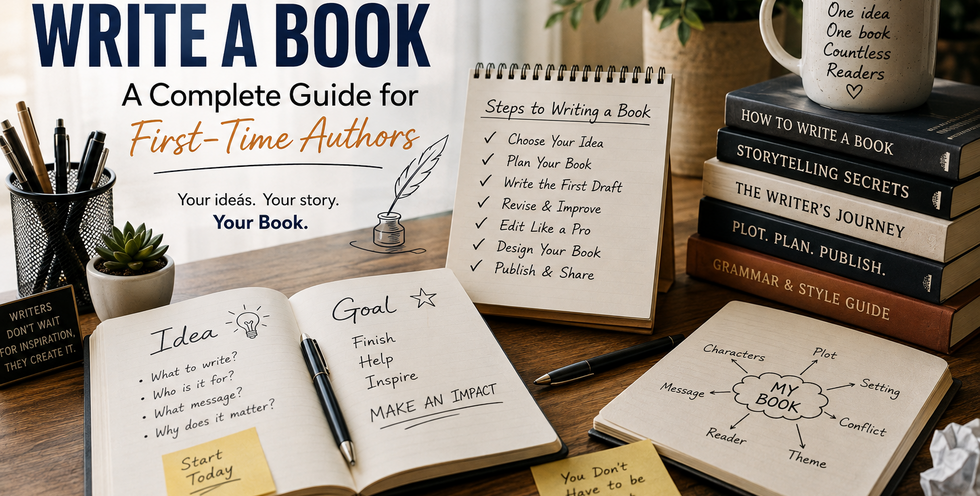
The rough sequence: idea → manuscript → editing → formatting → cover → KDP setup → publication → marketing. Each stage depends on the one before it, which is why skipping ahead usually just means redoing work later. Finish the book first. Everything downstream gets easier once there’s a finished manuscript to build from.
The Best Way to Write a Book Is to Start One
There’s no shortage of books about writing books, courses on writing books, and videos about writing books. Some of it is genuinely useful. Past a certain point, though, researching how to write becomes its own quiet way of avoiding the writing.
The best method is whichever one gets you consistently back to the page. Some writers outline everything before typing a word. Others discover the book as they go and clean it up in revision. Some do their best work at 6 a.m.; others don’t get going until midnight. Try a few approaches in your first couple of weeks and pay attention to which one you actually keep doing. That’s your answer — not whatever any guide, including this one, told you to do.
What If You Need Help Writing Your Book?
Needing help isn’t a sign you’re not a real author. It usually just means you’ve correctly identified the part of the process you’re weakest at.
Depending on where you’re stuck, the right kind of help might be:
- A writing coach, if you have the idea but keep losing momentum
- A developmental editor, if you have a full draft that isn’t quite working yet
- A copy editor or proofreader, if the manuscript is close and needs a technical pass
- A ghostwriter, if you have the knowledge or the story but not the time or writing background to produce the manuscript yourself
The clearer you can get about which of those is actually true for you, the easier it is to find the right person — instead of hiring a proofreader when what you actually needed was help with structure.
How BookCraftInk Can Help You Write, Edit, and Publish Your Book
You don’t have to figure out which of those you need on your own, either.
At BookCraftInk, we work with aspiring and established authors at every stage listed above — from a half-formed idea to a manuscript that just needs a final polish. Our services cover book writing and ghostwriting, book editing and proofreading, Amazon KDP publishing, self-publishing support, book cover design, author website development, audiobook production, and book marketing.
If you’re not sure yet what your project actually needs, that’s a fine place to start the conversation. We’d rather help you figure that out first than sell you the wrong service.
Final Thoughts
Looked at all at once, the full path from idea to published book is genuinely a lot. So don’t look at it all at once.
Develop the idea. Build a rough outline. Set a routine you can actually keep. Finish the draft, badly if that’s what it takes. Revise it. Get outside eyes on it. Then handle the production work that turns a manuscript into a published book.
You don’t need to understand KDP categories or cover design trends before you write your first chapter. You need to write the first chapter. Every published author you can name once had to write theirs, too — and none of them started with a perfect one.
Frequently Asked Questions
How do I start writing a book if I’ve never written anything before?
Start smaller than feels necessary: one clear idea, a one-sentence description of what it’s about, and a rough outline — even just a list of chapters. Set a writing target you can hit on a bad day, not only a good one, and begin. Experience comes from writing, not before it.
What are the main steps to writing a book?
In order: develop the idea, build a working outline, draft the manuscript, revise it structurally, get outside feedback, edit it (developmental, then line, then copyedit, then proofread), format it, and publish it. Marketing typically runs alongside the later stages rather than after them.
Do I need writing experience or a degree to write a book?
No. Most published authors, including many bestselling ones, never trained formally as writers. Readers and the market respond to whether the book is good and finished — not to the credentials behind it.
How much does it cost to get a book professionally edited or ghostwritten?
It varies widely based on manuscript length, how much work it needs, and who you hire — a light proofread costs far less than a full developmental edit or a ghostwritten manuscript built from scratch. It’s worth getting a quote based on your specific project rather than assuming a flat number, since scope affects price more than anything else.
Should I hire a ghostwriter, or write the book myself?
It depends on what you have more of: time and writing drive, or expertise and a story worth telling but limited bandwidth to write it. A ghostwriter works well when you have the substance but not the hours or writing background — the ideas and decisions still stay yours throughout the process.
Can I publish my book on Amazon myself?
Yes. Amazon’s KDP platform lets authors independently publish ebooks and print books without an agent or publisher. Many still bring in professional editing, formatting, and cover design first, since those are the details readers notice even when they can’t name what’s wrong.
What’s the difference between developmental editing, line editing, and copyediting?
Developmental editing addresses structure and big-picture issues. Line editing works on sentence-level clarity and voice. Copyediting handles grammar, consistency, and style rules. Most manuscripts benefit from going through them roughly in that order, since there’s little value polishing sentences in a section that might still get cut.