

You have revised the manuscript enough to know what you intended to write. The next question is harder: will someone reading it for the first time experience the book the way you hoped?
That is where beta readers can help. They bring a fresh reader’s perspective to a draft before publication, noticing where they become interested, confused, impatient, or emotionally invested.
To find beta readers, start with people who already read your genre or subject. Look in relevant writing communities, local groups, and your existing reader network. Share a clear invitation, agree on the scope before sending the manuscript, and ask questions that reveal the reading experience rather than simply requesting praise.
The aim is not to collect as many opinions as possible. It is to gather feedback you can understand and use.
What Is a Beta Reader?
A beta reader reads a draft and responds to it primarily as a reader. Depending on the project, they may comment on the story, characters, pacing, clarity, organization, or whether the book delivers what its opening promises.
They do not need to be professional writers. Someone who reads widely in your category may notice problems that have become invisible to you after repeated revisions.
The role should still be defined. One reader may expect to leave occasional comments, while another may prepare a detailed summary. Neither approach is automatically wrong, but you need to agree on what would be useful before the reading begins.
Beta reading is not a guarantee that a book is ready to publish. It is one way to understand how an audience responds to the version you share.
Beta Readers, Critique Partners, Editors, and ARC Readers
These roles can overlap, but the purpose of each arrangement matters more than the label.
| Role | Main purpose | What to clarify |
|---|---|---|
| Beta reader | Respond to the reading experience of a draft | Which questions to answer and how much detail is expected |
| Critique partner | Exchange writing feedback, often with a craft focus | Whether you are trading chapters, complete manuscripts, or ongoing support |
| Editor | Provide the editorial work defined in an agreed scope | Whether the work addresses structure, prose, consistency, or final errors |
| ARC reader | Read an advance copy, often close to publication | Whether you are seeking private reactions, publicity participation, or optional honest reviews |
An editor may offer substantial structural guidance, so editing should not be reduced to fixing punctuation. Equally, a beta reader may notice a grammatical issue without providing a complete copyedit.
Our explanation of the different types of book editing can help you separate these stages.
Do not quietly turn a beta-reading invitation into a request for a public review. Those are different activities. If you later invite someone to review a finished book, make that a separate, optional request and never require a positive opinion.
When Is a Manuscript Ready for Beta Readers?
For a whole-book beta read, aim to share a complete, readable draft that you have already revised yourself. The reader should be able to follow the work without repeatedly encountering missing scenes, drafting notes, or problems you already plan to fix.
That does not mean every sentence must be perfect. It means the draft is developed enough for the feedback to address the questions you actually need answered.
Before recruiting, ask yourself:
- Is the manuscript complete enough for a reader to assess the whole experience?
- Have I corrected obvious inconsistencies that would distract from that assessment?
- Do I know what I want to learn from this round?
- Am I willing to hear that part of the book is not working?
- Have I allowed time to revise after the feedback arrives?
There is no compulsory order that suits every project. Some authors seek structural editorial help before a beta round; others use reader reactions to identify what needs deeper attention. You may also use a focused beta round after a major revision.
If you only want reactions to an opening chapter or an unfinished section, say so. Do not present a partial draft as a full-book reading commitment.
Where to Find Beta Readers
1. Genre-Focused Writing Communities
Look for communities where your kind of book is already discussed. A group built around mysteries, historical fiction, memoir, or practical nonfiction can be more relevant than a large group with no shared reading interests.
Observe how the community works before making a request. Read the rules, use the appropriate channel, and contribute where you genuinely can. Do not send unsolicited manuscripts or copy the same recruitment message into unrelated discussions.
Reddit’s r/BetaReaders is one place to investigate. Its rules specify a request-title format that includes completion status, word count, genre, and a title or description. The rules also ask for substantive information rather than a post containing only a link. Check the current instructions before posting. 1
A community listing is a starting point, not an endorsement of every person who responds. Assess the individual reader and the proposed arrangement.
2. Local Writing Groups and Book Clubs
Ask a library, independent bookstore, or local writing organization whether it hosts a group that welcomes manuscript discussions.
A writing group may offer critique exchanges. A book club may give you access to readers who can describe what engages them without approaching every page as a writing exercise.
Neither group owes you a reading commitment. Ask the organizer whether the request is appropriate, explain the project briefly, and let interested members volunteer privately.
Local relationships can be especially useful when you want a conversation about the feedback. Still, agree on expectations just as clearly as you would with someone online.
3. Your Existing Reader Network
If you already have newsletter subscribers, website visitors, or people who regularly discuss books with you, invite interested readers to learn more about the draft.
Keep the invitation specific. Someone who enjoys your short posts may not have time to read a full manuscript. Explain the length, genre, broad subject, and the kind of response you need.
Give people a way to decline without embarrassment. Enthusiastic consent is a better starting point than a commitment made because someone feels they should support you.
If you are new and have no audience yet, that is not a reason to delay indefinitely. A relevant community or a small reciprocal arrangement may be enough to begin.
4. Reciprocal Critique Communities
An exchange can help you build relationships while learning to give clearer feedback yourself.
For example, Critique Circle describes a process in which members critique others’ stories, earn credits, and use those credits to submit their own work for review. Its workshop model is not the same as a guaranteed match with someone who will read your entire book.
Before joining an exchange, understand the submission limits, access settings, and work expected in return. Check the current rules rather than relying on an old list of platforms.
Agree on comparable commitments. Trading a short story for a full-length novel may be fine if both people genuinely want that arrangement, but it should not happen through an unclear assumption.
5. Friends and Family Who Fit the Audience
Someone close to you can be a useful reader if they understand the genre, can respond honestly, and are comfortable separating their reaction to the book from their relationship with you.
The problem is not that they know you. The problem is relying entirely on people who may soften every criticism or who would never choose this kind of book.
Include perspectives outside your immediate circle when possible. Ask for observations rather than reassurance, and do not make the relationship depend on an enthusiastic response.
How to Choose the Right Beta Readers
A willing reader is not automatically the right reader for this particular round.
Ask what they enjoy reading and what interests them about your project. Someone does not need to agree with every choice you make, but they should understand the experience your book is trying to offer.
Discuss availability, preferred file format, and comfort with the material. If the book contains potentially distressing content, provide enough information for an informed choice without pressuring anyone to read it.
You might begin with a small sample so both sides can judge whether the arrangement fits. Do not use that sample to demand extensive unpaid editorial work from everyone who expresses interest.
Start with a group you can realistically coordinate. A handful of relevant readers can be more manageable than a large list of uncertain commitments. There is no universal number that makes feedback representative or guarantees the right conclusion.
Write a Clear Beta-Reader Invitation
A useful invitation tells someone what they are considering before they agree.
Include the genre or subject, intended audience, word count, draft status, a short premise, relevant content notes, and the feedback you want. Explain whether you are offering a swap and ask about timing rather than imposing an unexpected deadline.
Here is a fictional example:
I am looking for beta readers for a complete, revised cozy mystery of approximately 68,000 words. The story follows a community gardener investigating a disappearance connected to a local seed exchange. I would especially value reactions to the opening, the clarity of the clues, and whether the ending feels supported by the earlier chapters. I can share a short sample first. If the project interests you, let me know what reading schedule would be realistic and whether you would like to discuss a manuscript swap.
Adapt the details to your actual book and add any content notes your readers need. If you post in a community, use its required format rather than assuming this paragraph replaces the rules.
Do not promise publication credit, access to future work, or another benefit unless you intend to provide it and have agreed on what it means.
Prepare the Manuscript and Set Expectations
Send a clean, clearly labeled file with a version name or date. Include chapter headings and page numbers where the format supports them, so readers can identify where a reaction occurred.
Agree on the delivery method. Some readers prefer document comments, while others work better with a separate response form. Choose a method that both of you can use comfortably.
Before sharing the full draft, explain:
- What you want the reader to focus on.
- Whether comments during reading or a final summary would be more helpful.
- The agreed schedule and how to communicate if it changes.
- Whether the file should remain private and must not be forwarded or uploaded elsewhere.
- Whether you permit the text to be processed through any outside tool, including AI tools.
- What happens if the reader stops or decides the book is not a fit.
Use access controls where available and keep your own backups. Sharing a manuscript always involves some risk; a watermark or private link is not a guarantee against copying. Avoid including unnecessary personal information in the file.
Do not replace the draft repeatedly while people are reading it. Finish the round on a stable version unless there is an important reason to stop and restart by agreement.
Beta Reader Questions That Lead to Useful Feedback
“Did you like it?” is a reasonable conversation starter, but it rarely gives you enough information to plan a revision.
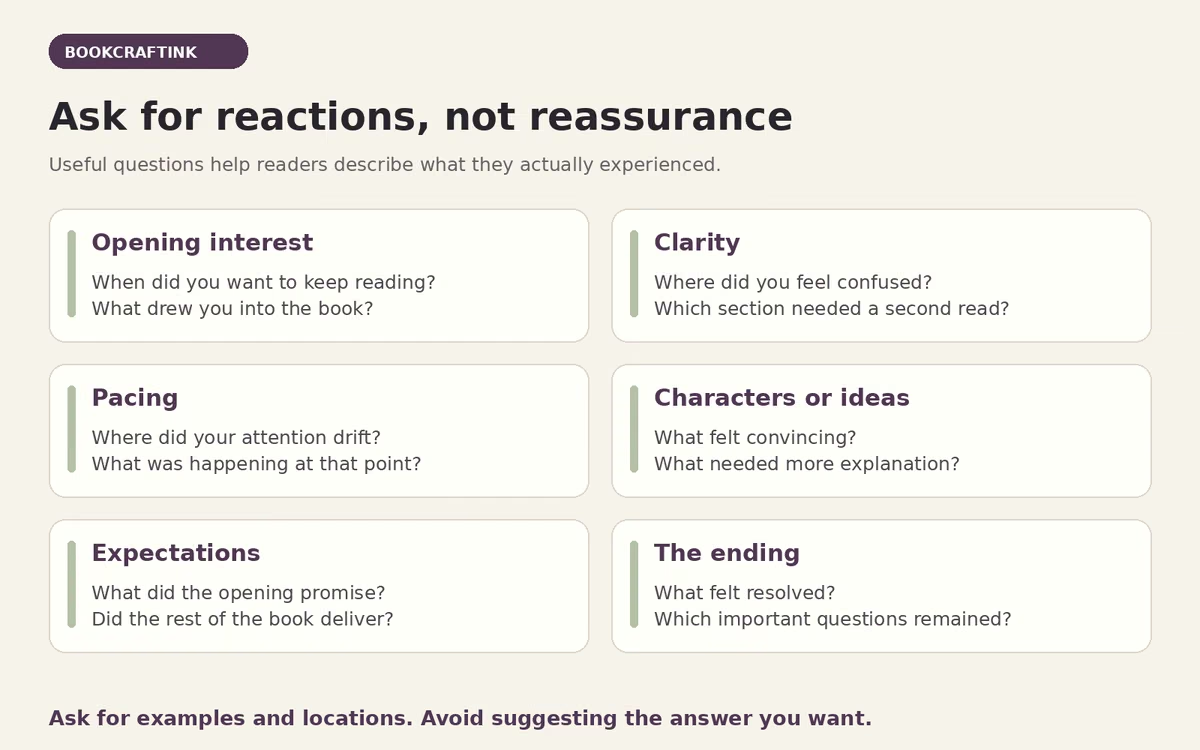
Ask open questions that help readers identify their experience. Avoid wording that tells them what answer you hope to receive.
| Area | A useful question |
|---|---|
| Opening | At what point did you become interested, and what made you want to continue? |
| Clarity | Where did you feel confused or need to reread? Please identify the scene or section. |
| Pacing | Where did your attention drift, and what was happening at that point? |
| Characters or ideas | Which decisions or explanations felt convincing, and which needed more support? |
| Expectations | What did you expect the book to deliver after reading the opening? |
| Ending | What felt resolved, and what important questions remained? |
| Audience fit | Who do you think would enjoy or benefit from this book? |
For nonfiction, ask readers to identify unfamiliar terms, missing steps, or places where an example would help. A subject-matter expert and a newcomer may notice different problems, so make clear which perspective you are asking each person to bring.
For fiction, ask about motivation, tension, emotional response, and the information readers had when a major event occurred. Avoid demanding a solution to every issue they notice.
Keep the questionnaire focused. Select the questions relevant to this round and leave room for something you did not think to ask.
How to Use Beta-Reader Feedback Without Rewriting Everything
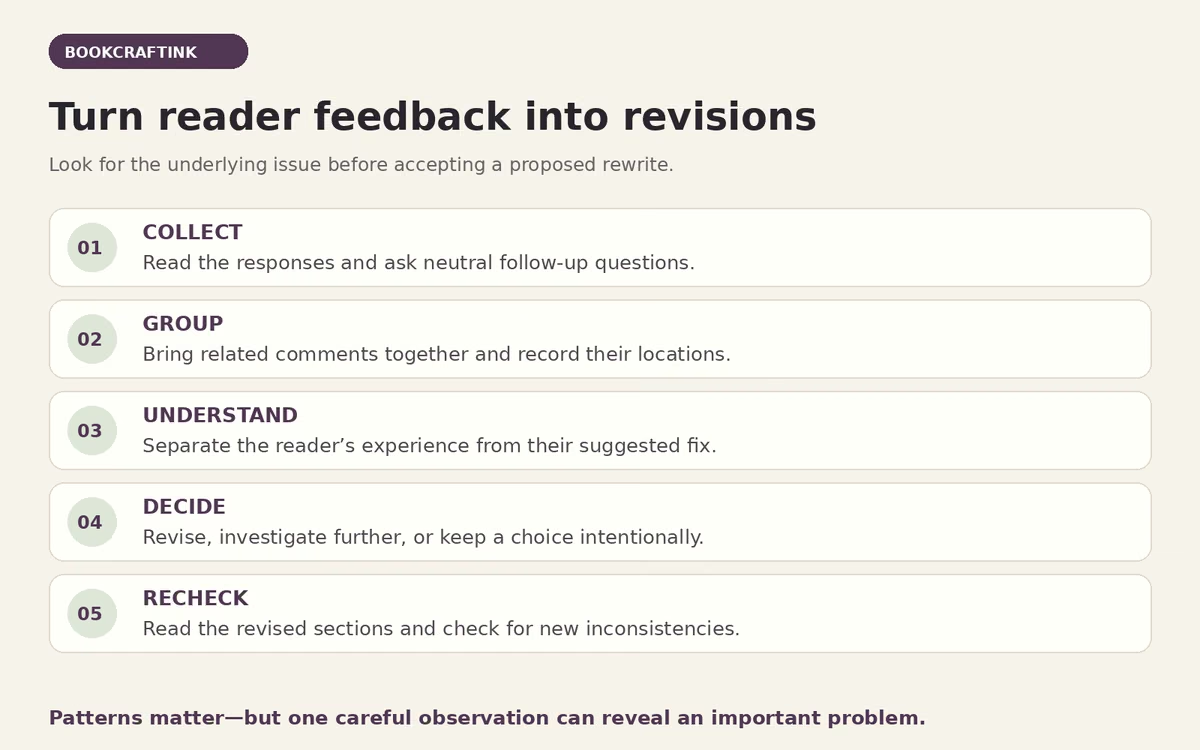
Collect the Responses Before Reacting
Thank readers for their time and read the feedback carefully. You do not need to defend every choice or make an immediate revision while the comments are still arriving.
If something is unclear, ask a neutral follow-up: “What did you think the character wanted in that scene?” usually reveals more than “Did you miss the explanation in chapter two?”
A reader’s misunderstanding is information. It does not automatically mean the reader is wrong or that your entire scene must be replaced.
Group Notes by the Underlying Issue
Bring related comments together. “The middle felt slow,” “I lost track of the goal,” and “I stopped caring about the investigation” may describe connected problems even though the wording differs.
Record where the issue occurred and what the reader experienced. Preserve the original comments so you can check whether your summary is fair.
Look for patterns, but do not turn the process into a vote. One reader may notice an important contradiction that everyone else missed. Several readers may also suggest different solutions to the same underlying problem.
Separate Observations From Proposed Fixes
A reader may correctly identify confusion but suggest a change that does not fit your book.
For a hypothetical example, a reader says: “The sister should explain the whole plan before the argument.” The useful observation might be that the argument depends on a motivation the reader cannot yet understand. Your revision could clarify that motivation without adding a speech that gives away the plot.
Ask what the comment reveals before accepting its proposed rewrite.
Make a Revision Plan
Sort the notes into practical decisions:
- Revise: You understand the problem and have a change worth making.
- Investigate: You need to reread the section or ask a clarifying question.
- Keep intentionally: The choice serves the book, and you understand the trade-off.
Address structural issues before polishing sentences that may disappear. Keep a brief record of the changes you make and the reason for each one.
Then recheck the affected sections. A repair in one chapter can create a new inconsistency somewhere else. If the revision changes a major part of the reading experience, a focused second round may be useful.
Common Beta-Reading Mistakes to Avoid
Recruiting anyone who says yes. Availability matters, but so does relevance to the audience and the question you are trying to answer.
Sharing a draft you already know is incomplete. Be honest about its stage and match the request to what readers can realistically assess.
Asking leading questions. “Was the exciting opening effective?” assumes the opening was exciting. Let the reader describe it first.
Expecting a copyedit. Reader reactions and systematic editorial work are different commitments.
Arguing with every negative response. Clarify when needed, but do not try to persuade someone that they enjoyed a scene they found frustrating.
Treating every suggestion as an instruction. You remain responsible for the manuscript’s decisions and consistency.
Forgetting to close the loop. Thank readers, explain when the round has finished, and ask permission before sharing their comments publicly or naming them in acknowledgments.
Turn Reader Reactions Into a Stronger Manuscript
Finding beta readers is only the first part of the process. The useful work comes from choosing appropriate readers, setting a clear scope, asking focused questions, and examining the feedback without rushing to defend or rewrite everything.
A good round should help you understand the gap between what you intended and what readers experienced. It does not remove the need for your judgment or for appropriate editorial support.
When you are ready to plan the next stage, our self-publishing fiction guide explains the broader workflow. You can also contact BookCraftInk to discuss your manuscript stage, the feedback you have received, and the support you want next.
Frequently Asked Questions
Where can I find beta readers for my book?
Look in genre-focused writing communities, local writing groups, relevant book clubs, and your existing reader network. Reciprocal critique communities can also help you build relationships. Read each community’s rules and assess individual readers rather than assuming everyone on a platform is suitable.
How many beta readers do I need?
There is no universal number. Start with a manageable group of relevant readers whose responses you can review carefully. More feedback is not automatically better, and a repeated opinion is not the only signal worth considering. One well-supported observation may reveal an important issue.
Should I use beta readers before or after editing?
It depends on the manuscript and the purpose of the round. You might use readers after self-revision, after structural editing, or to test a major rewrite. Do not treat beta reading as a substitute for every editorial stage or assume there is one mandatory sequence.
Can friends and family be beta readers?
Yes, if they understand the intended audience, can respond honestly, and agree to the scope. Avoid relying only on people who feel obliged to encourage you. Include other perspectives when possible and make clear that criticism will not harm the relationship.
What should I ask beta readers?
Ask where they became interested, confused, disengaged, or emotionally involved. Request locations or examples rather than only a general verdict. Tailor the questions to your manuscript and avoid telling readers which response you hope to receive.
What if my beta readers disagree?
Check whether they are describing different preferences or different reactions to the same underlying issue. Compare their expectations with your intended audience and reread the relevant section. You do not have to satisfy every suggestion, but you should understand the feedback before dismissing it.
Do beta readers replace professional editors?
No. Beta readers primarily provide reader reactions, while an editor performs the work defined in an editorial scope. A reader may spot a typo or a structural problem without delivering a complete copyedit or developmental edit. Use each kind of support for the task it is meant to address.